Events Engine
How we built AI agents to help our sales team identify events and connect with better leads.
Build your story
We stopped chasing events, and started closing more deals.
Our sales team used to waste hours scrolling through event lists, hoping to find the right rooms and the right people. Now, our agentic events engine pinpoints high-impact conferences where our ideal customers will be.

Designed for impact.
What used to take hours of scrolling and Slack threads is now automated, prioritized, and actionable.
Manual search time reduced from 3–4 hours/week to under 20 minutes
85% of events retrieved have high relevance scores, and match rep-defined criteria for a “good event”
Event decisions are made 2x faster with higher confidence and better outcomes
Automated discovery
Agents continuously surface high-impact events based on custom ICP criteria.
Faster, smarter decisions
Cut through the noise with clear relevance scores, so teams can prioritize quickly and use travel budgets wisely.
Full context, at a glance
Instantly see each event’s location, timing, estimated budget, and strategic fit. No more piecing details together manually.

Seamless team alignment
Share event insights, shortlists, and decisions effortlessly, keeping everyone in sync and focused on ROI.
Reps spend less time searching and more time connecting, resulting in more revenue opportunities.

Events Engine Design Principles.
- Agents are scouts, not gatekeepers: Agents surface the best-fit opportunities, but final calls stay with humans. The system highlights what's worth a look, humans still make their own choices.
- Continuous improvement: Every skip, click, or "hell yes" makes the engine smarter. By guiding the agents with real-world preferences and patterns, humans shape how discovery evolves.
- Discovery should be fun: Playful, interactive UI keeps things light and clear, so finding networking opportunities isn’t a chore, but a delightful adventure.
- Adaptability: The engine can be customized for any team or any type of event, giving Worthwhile a powerful, scalable product worth sharing.
AI Capabilities
employed:
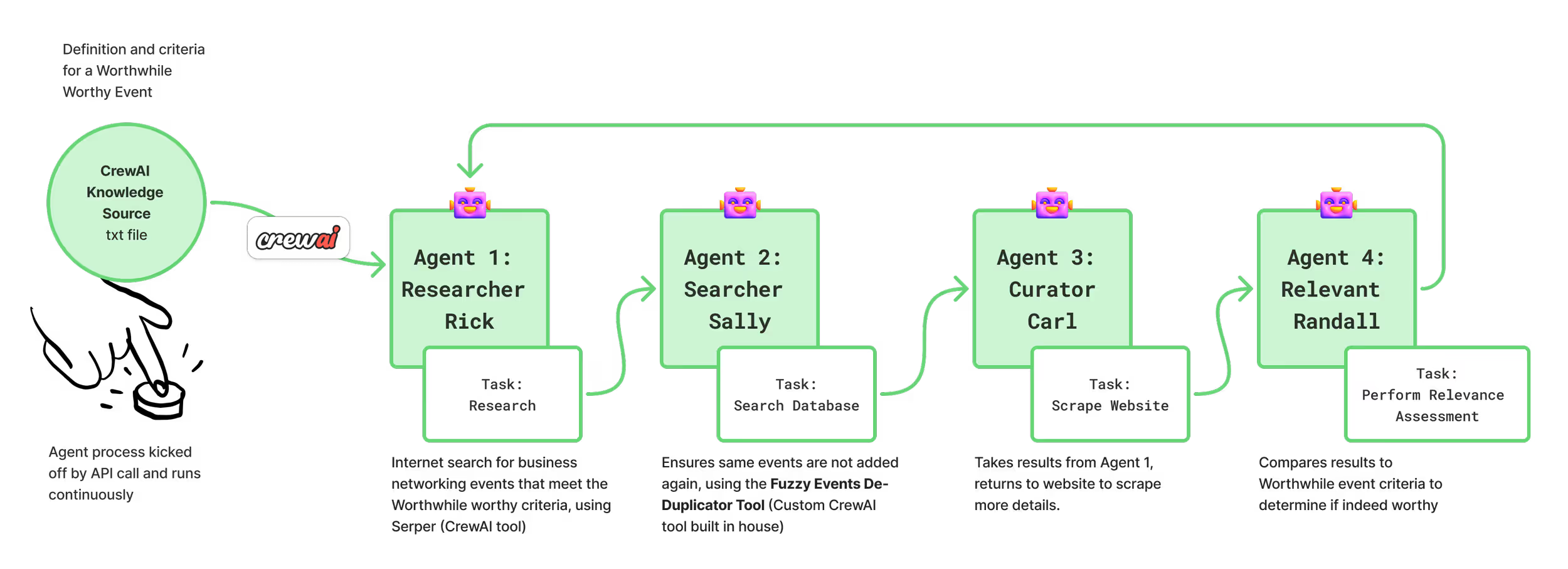
To transform a messy, manual process into a focused, strategic advantage, we built a multi-agent engine using the CrewAI framework, integrated into a Django application with Python and Postgres.
Each agent performs a specialized task (surfacing relevant events, deduplicating listings, analyzing relevance scores) using OpenAI’s GPT-4.1 as the core reasoning model.
Core tools behind the engine:
- Serper Web Search & Selenium: To fetch, scrape, and explore events on external webpages
- Custom Fuzzy Matching Tool: Built in-house to remove duplicates across messy data sources
- CrewAI Knowledge System: Populated with key event types and decision criteria
Why CrewAI?
We chose CrewAI for its clarity, modularity, and active support ecosystem which allows rapid experimentation while maintaining structure and control. This modular architecture lets us evolve agent behavior and tooling without slowing down the team.
Human-guided, iteration-driven.
Agents present options, but people make the calls. Each week, we review agent outputs, refine prompt strategies, add new tools, and prioritize improvements based on real-world use cases. This human-in-the-loop model ensures the system stays grounded in actual sales workflows.
What’s next?
While CrewAI offered speed and flexibility, we learned that consistent iteration and human feedback loops are essential for reliability and trust.
Going forward, we’ll explore agent memory, user-specific personalization, and more dynamic team workflows.
We also see this as a repeatable solution for partner orgs looking to improve event ROI at scale.