People Before Platform: Why Your Team, Not Your Tech, Decides If AI Works
What if the key to unlocking real AI value isn't the technology but understanding users' biggest frustrations? Discover how a human-centered approach to AI reveals high-impact use cases that drive business results by transforming the user experience.
Have you ever thought, “We need to add AI to this…” but didn’t know where to begin?
You’re not alone. This kind of tech-first thinking is common among leaders of small and mid-sized businesses who know they need to enhance their software and digital products with AI, but feel stuck on where to start.
By leading with a tech only readiness assessment an important failure point is overlooked: adoption. In MIT's State of AI in Business 2025 report, 95% of AI pilots delivered no measurable value. In the same stretch, 42% of companies scrapped most of their AI projects. (SOURCE) These stats did not cite a tool failure problem, but rather people that weren’t ready to use them.
A human-first start flips the order. Before you decide what AI to add, find out whether your people can adopt it.
What is human-first AI readiness?
Human-first AI readiness measures whether your people are prepared for AI, not just your data and infrastructure. That means two groups: the users you serve, and the team expected to support the tools day to day. Systems matter for implementation. But people are where adoption is won or lost.
Why AI initiatives fail at the adoption phase
When a readiness check only looks at infrastructure, it misses the part that actually stalls most rollouts: whether the organization will use what gets built. Tech-first readiness carries a blind spot, and it surfaces at the adoption phase. The research agrees. WalkMe's study of how employees actually use AI found that people are often eager to try the tools but do not feel equipped or safe enough to adopt them, and that gap quietly drains the return. (SOURCE)
Our own conversations with clients surface the same road bumps, again and again. As one leader put it: "Does it sit on the shelf, or is it going to do something?"
- Change fatigue. AI often arrives during a season of upheaval. New leadership, an acquisition, a strategy pivot, a round of layoffs. By the time a new tool shows up, the team is already worn down by everything that came before it, and one more change feels like too much.
- Perceived tool complexity. Some employees have spent decades mastering legacy software. It may be clunky, but it is familiar. A new tool with new training and new capabilities can read as complicated rather than helpful. Knowing a tool exists is very different from folding it into daily habit.
- Invisible readiness signals. Teams assume that if the data is clean and the systems can integrate, they are ready. They are not. Technical readiness and human readiness are different things, and unless you have measured the human side directly, you are guessing at it.
- Fear of job replacement. This is the loudest message around AI right now, so your people arrive wary no matter how you frame it internally. Left unaddressed, that fear does not just slow adoption. It can tip into quiet resistance, and in the worst cases, active sabotage.
- Leadership that is not aligned. When outside sales, inside sales, and finance each believe the work should be done a different way, AI does not settle the argument. Without a shared answer to why AI matters here, adoption fractures along the same lines the leadership team already does.
How to avoid AI adoption failure
You avoid adoption failure the way you avoid any expensive mistake. You look before you leap. That means two things, in this order. First, evaluate whether your team is actually ready. Second, fix the gaps you find before you layer AI on top. Skip either step and you are back to buying a tool that sits on the shelf.
First: Evaluate your team’s AI readiness
Most readiness checks score one thing: the technology. Is the data clean, will the systems integrate, is the infrastructure in place. Those questions matter, but they answer only half the question. A complete evaluation scores the human side too, because that is where adoption is won or lost.
A ready organization tends to show a handful of clear signals:
- Leadership agrees on why AI matters here, and can say it in one sentence.
- People understand what AI will and will not change about their jobs, so the fear is named instead of left to fester.
- The team has the bandwidth and the appetite for change right now, not stacked on top of three other transitions.
- There is a plan to bring people along, not just a plan to deploy a tool.
- Someone has actually measured the signals above, rather than assuming them.
Surfacing the red flags on team readiness is not a failure. In fact, it is an opportunity to create a stronger foundation.
We created an assessment for this. We evaluate your tech readiness and your human readiness to give you a complete readiness score. Take the assessment here →
Second: Fix the foundation
One of the biggest takeaways from your team’s readiness score is this: the gaps that were surfaced are not problems meant to be solved with AI. These are strictly issues that must be addressed beforehand.
In practice that might mean getting your leadership team to a shared answer on why AI matters here. It might mean addressing job-security fears out loud rather than hoping they fade. It might mean waiting until the current wave of change has settled so a new tool does not land on an already exhausted team. None of this is glamorous, but all of it is cheaper than a failed rollout.
Best strategy for employee AI adoption: a human-centered approach
Readiness gets your organization prepared to adopt AI. The next question is where to point it. The strongest use cases come from the same place adoption does: real human friction. This is the layer of AI strategy clients come to us for, and it is how you find use cases worth the investment instead of AI for its own sake.
Here is how it looks in practice:
Step 1: Map the Current User Journey
Start by mapping how users (or internal teams) currently experience your product, service, or system. What are their Jobs to Be Done? What outcomes do they care about that also align with your business goals? Each column in the chart below is a touchpoint, which can be turned into a use case.
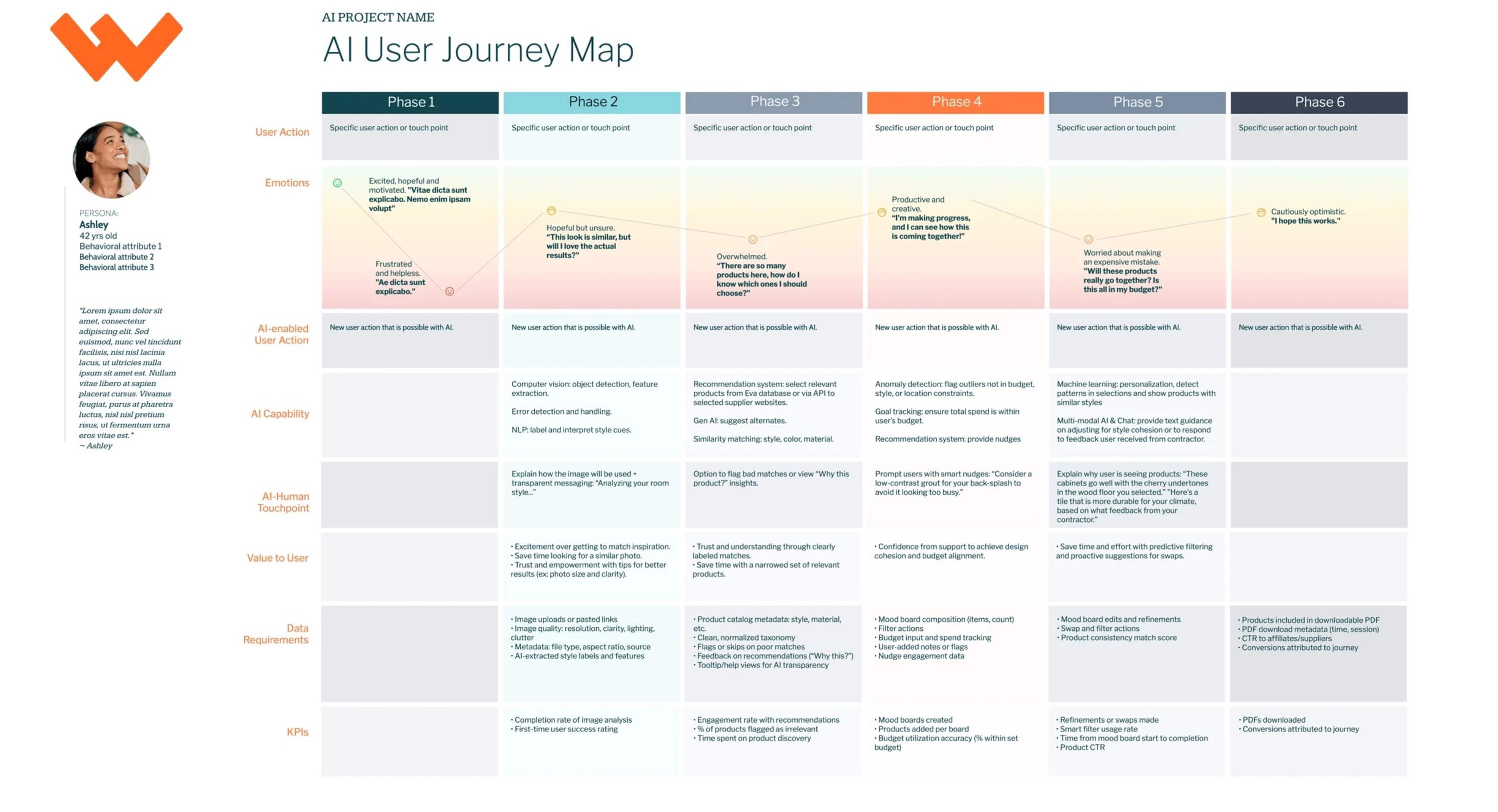
Read how this was done in the Eva case study →
Step 2: Plot the Emotional Experience
Next, explore the emotional highs and lows (row two of the chart above). Where are users feeling frustrated, overwhelmed, or confused? These moments point to your biggest opportunities or adoption failures mentioned in the earlier section.
Step 3: Layer in AI Capabilities
Here is where your team brainstorms how to apply current AI technologies (ex: recommendation systems, computer vision, NLP, machine learning, etc.) that could reduce friction, provide insights, or automate tedious tasks.
Step 4: Design for adoption
This is where you take the emotional low points from Step 2 and decide how each one gets bridged, so the AI actually gets used.
When the users are your own team, that means meeting the fears head on. Name what the tool will and will not change about someone's job. Plan the rollout so it does not land on an already exhausted team. Give people a reason to trust it before you ask them to rely on it.
When the users are external, the same principle applies to the product experience. Lower the friction of a new interaction, make the AI's reasoning visible, and give people control instead of forcing the change on them.
Either way, be honest about which pain points AI should not touch. Some friction is a process or design problem, and forcing AI onto it only adds cost and confusion. Fix those the simple way, and save AI for where it earns its place.
Step 5: Prioritize and Scope the MVP
Now it’s time to prioritize use cases based on value, effort, and feasibility. Which ones will deliver the biggest impact if we apply the right AI capability? Where can you achieve the most meaningful results with manageable effort?
This process shapes a clear, testable MVP by seamlessly integrating AI capabilities into your user’s workflow where it matters most.
We’ve applied this process across various industries and business models. It scales whether you're launching your first AI pilot or enhancing a mature product.
For more information, visit the Human Centered AI Institute: www.hcaiinstitute.com
Start with the people, not the platform
Every failed AI rollout shares a root cause. It led with the technology and treated the people as an afterthought. The ones that work run the other way. They start with a real human problem and a team prepared to adopt the solution.
If that sounds like a lot to get right before you have even picked a tool, here is the reassuring part. Most organizations are more ready than they fear. The gaps an honest evaluation surfaces are rarely dealbreakers. They are simply the work worth doing first, and knowing about them is a strength, not a setback.
Not sure where your organization stands today? Start with the readiness assessment. It takes a few minutes and gives you an honest read on where you are before you invest a dollar in AI.
Human AI readiness FAQs
How do I know if my company is ready for AI?
Look past the technology. A ready organization usually shows a few clear signals: leadership can explain in one sentence why AI matters here, employees understand what the tool will and won't change about their jobs, the team has real bandwidth and appetite for change right now, and there's a plan to bring people along — not just to deploy a tool. If you can't check those boxes, the gap is on the human side, and it's worth measuring before you buy anything.
What's the difference between tech-first and human-first AI readiness?
Tech-first readiness asks whether your data is clean and your systems can integrate. Human-first readiness asks whether your people, both the team supporting the tool and the users you serve, are actually prepared to use it. Both matter, but adoption is won or lost on the human side, which is the half most assessments skip.
How do I get my team to actually use new AI tools?
Meet the friction instead of issuing a mandate. Address job-security concerns openly, avoid dropping a new tool on a team already worn down by other changes, and give people a reason to trust it before you ask them to rely on it. Adoption follows trust and early visible wins far more reliably than it follows a top-down "we're using AI now."
What is change fatigue, and how does it affect AI adoption?
Change fatigue sets in when AI arrives in the middle of everything else: new leadership, an acquisition, a strategy pivot, a round of layoffs. The team is already stretched, so one more change reads as too much. Sometimes the smartest move is waiting until the current wave settles before layering on a new tool.